
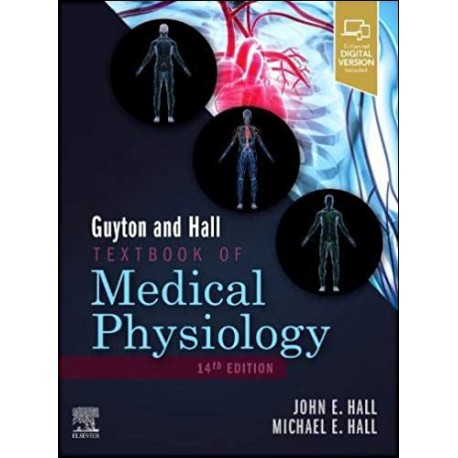

GUYTON AND HALL TEXTBOOK OF MEDICAL PHYSIOLOGY (ENHANCED DIGITAL VERSION INCLUDED)
9780323597128
Más información
DESCRIPTION
Known forits clear presentation style, single-author voice, andfocus on content most relevant to clinicaland pre-clinicalstudents, Guyton and Hall Textbook of Medical Physiology, 14thEdition, employs a distinctiveformat to ensure maximum learning and retentionof complex concepts. A larger font size emphasizescore information, while supporting information, including clinical examples, are detailed in smaller font and highlightedin pale blue - making it easy toquickly skim the essential textor pursue more in-depth study. Thistwo-tone approach, along with other outstandingfeatures, makes this bestselling text a favorite of students worldwide.
· Offers a clinically oriented perspective written with the clinicaland preclinical student in mind, bridging basic physiology with pathophysiology.
· Focuses on core material and how the body maintains homeostasis to remain healthy, emphasizing the important principles that will aidin later clinical decision making.
· Presents information in short chapters using a concise, readable voice that facilitates learning and retention.
· Contains more than 1,200 full-color drawings and diagrams - all carefully craftedto make physiologyeasier to understand.
· Features expanded clinical coverage including obesity, metabolic and cardiovascular disorders, Alzheimer's disease, and other degenerativediseases.
· Includes online access to interactive figures, new audio of heart sounds,animations, self-assessment questions, and more.
· Enhanced eBook version included with purchase. Your enhanced eBook allows you toaccess all of the text,figures, and references from the bookon a variety of devices.
TABLE OF CONTENTS
I. Introduction to Physiology: The Cell andGeneral Physiology
1. Functional Organizationof the Human Body and Control of the "Internal Environment"
2. The Celland Its Functions
3. Genetic Control of Protein Synthesis,cell function, and cell reproduction
II. MembranePhysiology, Nerve, and Muscle
4. Transport ofSubstances Through Cell Membranes
5. Membrane Potentialsand Action Potentials
6. Contraction ofSkeletal Muscle
7. Excitation ofSkeletal Muscle: NeuromuscularTransmission and Excitation-Contraction Coupling
8. Excitation andContraction of Smooth Muscle
III. TheHeart
9. Cardiac Muscle;The Heart as a Pump and Functionof the HeartValves
10. Rhythmical Excitationof the Heart
11. The Normal Electrocardiogram
12. Electrocardiographic Interpretation of Cardiac Muscle and Coronary BloodFlow Abnormalities:Vectorial Analysis
13.CardiacArrhythmias and Their Electrocardiographic Interpretation
IV. The Circulation
14. Overview ofthe Circulation; Biophysics of Pressure,Flow, and Resistance
15. Vascular Distensibility and Functions ofthe Arterial and Venous Systems
16. The Microcirculationand Lymphatic System: Capillary Fluid Exchange,Interstitial Fluid, and Lymph Flow
17. Local and Humoral Control of Tissue BloodFlow
18. Nervous Regulationof the Circulationand Rapid Control of Arterial Pressure
19. Role of theKidneys in Long-TermControl of Arterial Pressureand in Hypertension: The Integrated System for AterialPressure Regulation
20. Cardiac Output, Venous Return, and Their Regulation
21. Muscle BloodFlow and Cardiac Output During Exercise; the CoronaryCirculation and Ischemic Heart Disease
22. Cardiac Failure
23. Heart Valvesand Heart Sounds; Valvular and Congenital Heart Defects
24. Circulatory Shock and Its Treatment
V. The Body Fluidsand Kidneys
25. The Body Fluid Compartments: Extracellular and Intracellular Fluids; Edema
26. The UrinarySystem: Functional Anatomy and UrineFormation by the Kidneys
27. Glomerular Filtration, Renal Blood Flow, andTheir Control
28. Renal Tubular Reabsorption and Secretion
29. Urine Concentrationand Dilution; Regulation of ExtracellularFluid Osmolarity and Sodium Concentration
30. Renal Regulation of Potassium, Calcium,Phosphate, and Magnesium; Integration of Renal Mechanisms for Control of Blood Volume andExtracellular Fluid Volume
31. Acid-Base Regulation
32. Diuretics, KidneyDiseases
VI. Blood Cells,Immunity, and Blood Coagulation
33. Red Blood Cells,Anemia, and Polycythemia
34. Resistance ofthe Body to Infection: I. Leukocytes, Granulocytes, the Monocyte-Macrophage System, and Inflammation
35. Resistance ofthe Body to Infection: II. Immunity and Allergy
36. Blood Types;Transfusion; Tissue and Organ Transplantation
37. Hemostasis and Blood Coagulation
VII. Respiration
38. Pulmonary Ventilation
39. Pulmonary Circulation,Pulmonary Edema, Pleural Fluid
40. Principles ofGas Exchange; Diffusion of Oxygen and CarbonDioxide Through the Respiratory Membrane
41. Transport ofOxygen and Carbon Dioxide in Blood and TissueFluids
42. Regulation ofRespiration
43. Respiratory Insufficiency - Pathophysiology,Diagnosis, Oxygen Therapy
VIII. Aviation,Space, and Deep-Sea Diving Physiology
44. Aviation, HighAltitude, and Space Physiology
45. Physiology ofDeep-Sea Diving and Other HyperbaricConditions
IV. The Nervous System: A. General Principles and Sensory Physiology
46. Organization of the NervousSystem, Basic Functions of Synapses, andNeurotransmitters
47. Sensory Receptors,Neuronal Circuits for Processing Information
48. Somatic Sensations:I. General Organization, theTactile and Position Senses
49. Somatic sensations:II. Pain, Headache, and ThermalSensations
X. The NervousSystem: B. The Special Senses
50. The Eye:I. Optics of Vision
51. The Eye:II. Receptor and Neural Function of theRetina
52. The Eye:III. Central Neurophysiologyof Vision
53. The Senseof Hearing
54. The ChemicalSenses - Taste and Smell
XI. The Nervous System: C. Motor and Integrative Neurophysiology
55. Motor Functions of the SpinalCord; the Cord Reflexes
56. Cortical and Brain Stem Control of Motor Function
57. Contributions of the Cerebellumand Basal Ganglia to Overall Motor Control
58. Cerebral Cortex, Intellectual Functions of the Brain,Learning, and Memory
59. Behavioral andMotivational Mechanisms of the Brain- The Limbic System and theHypothalamus
60. States ofBrain Activity - Sleep, Brain Waves,Epilepsy, Psychoses, and Dementia
61. The AutonomicNervous System and the Adrenal Medulla
62. Cerebral Blood Flow, Cerebrospinal Fluid, and Brain Metabolism
XII. Gastrointestinal Physiology
63. General Principles of Gastrointestinal Function - Motility, Nervous Control, and Blood Circulation
64. Propulsion andMixing of Food in the AlimentaryTract
65. Secretory Functionsof the AlimentaryTract
66. Digestion andAbsorption in theGastrointestinal Tract
67. Physiology ofGastrointestinal Disorders
XIII. Metabolismand Temperature Regulation
68. Metabolism ofCarbohydrates and Formation of AdenosineTriphosphate
69. Lipid Metabolism
70. Protein Metabolism
71. The Liver as an Organ
72. Dietary Balances; Regulation of Feeding;Obesity and Starvation; Vitamins and Minerals
73. Energetics andMetabolic Rate
74. Body Temperature Regulation and Fever
XIV. Endocrinologyand Reproduction
75. Introduction to Endocrinology
76. Pituitary Hormones and Their Control by the Hypopthalamus
77. Thyroid MetabolicHormones
78. Adenocortical Hormones
79. Insulin, Glucagon,and Diabetes Mellitus
80. Parathyroid Hormone, Calcitonin, Calcium and PhosphateMetabolism, Vitamin D, Bone, and Teeth
81. Reproductive and Hormonal Functions of the Male (andFunction of the Pineal Gland)
82. Female PhysiologyBefore Pregnancy and Female Hormones
83. Pregnancy andLactation
84. Fetal and Neonatal Physiology
XV. Sports Physiology
85. Sports Physiology
Reseñas
No hay reseñas de clientes en este momento.
9 otros productos de la misma categoría:
-

KIT DE CRIOTERAPIA CRY-AC 0.3 L
1 025,00 €
-
LAPARO ASPIRE VER. MEDIUM. LAPAROSCOPIC TRAINER
680,50 €
-

ADAPTADOR DE CORRIENTE ELECTRICA OMRON M2, M3, M6 IT, M7, M10 IT
19,80 €
-

FUNDA FONENDOSCOPIO CARE COLLECTION
9,95 €
-

FUNDA FONENDOSCOPIO VIRUS COLLECTION
9,95 €
-
FUNDA FONENDOSCOPIO EIGHTIES COLLECTION
9,95 €
-

GUIA PRACTICA PARA PROFESORES DE MEDICINA
72,20 € -5% 76,00 €
-

LAPARO ASPIRE VER. ESSENTIAL LAPAROSCOPIC TRAINER
638,28 €
-

FUNDA FONENDOSCOPIO ORGANOS
9,95 €


LibreriaMedica.es
 Conócenos

Estudiantes
 Estudiantes