
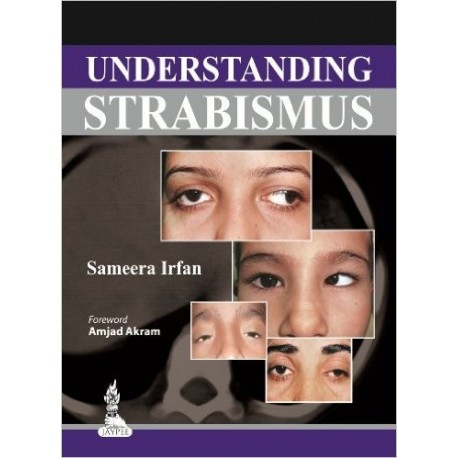

UNDERSTANDING STRABISMUS
9789350909904
Más información
QUICK OVERVIEW
The subjectof strabismus is like a vast ocean; standing by its shores, one cannot assessits full expanse but only by taking a deep plunge into it does one realize itstrue depth and dimension. Eyes are the organs that receive and reflect theintelligence of thought and the warmth of sensibility. According to JC Lavater, Physiognomist(London, 1826),The images of our secret agitations are particularly painted in the eyes. Theeye at once receives and reflects the intelligence of thought, and the warmthof sensibility. It is the sense of the mind, the tongue of the understanding. Hence,it is our duty and responsibility as strabismologiststo ensure equal vision in both eyes, which are, therefore, locked into equaland simultaneous movement in all directions.
Strabismus (squint) is a sign; it is Natures way of tellingus that something is wrong with the eye itself, either structurally orfunctionally, or with the visual pathways and higher centerscontrolling the ocular motility. It has a multifactorialetiology. In order to plan the correct management, itis important to find the causative factors and an attempt should be made torectify them first before embarking on strabismus surgery. A clear conceptualknowledge of refractive errors is mandatory to understand it completely. About80-85% cases of strabismus are due to mismanaged refractive errors. A soundunderstanding of refractive errors is the backbone of strabismus management.
It is also very important to realize that except the trulyEssential Infantile Esotropia, all other kinds ofstrabismus have defective vision in either one or both eyes as a contributoryfactor. Normally, equal visual acuity in both eyes causes a state of sensoryfusion that locks the two eyes to move together. If this locking mechanism doesnot occur due to poor vision in one eye, that eye either turns inwards (esotropia) in an infant or a toddler or it turns outwards (exotropia) if visual loss occurs after the age whenaccommodation is less active.
KEY FEATURES
Themanagement of a patient with strabismus is one of the most challenging tasksfor trainee ophthalmic surgeons and general ophthalmologists.
This book is clinically oriented; it decribesthe clinical management of all varieties of strabismus in a step-wise andsimplified manner which is very easy to follow.
Strabismus surgery is the second most common major ophthalmicsurgical procedure after cataract surgery. The basic surgical principles,indications and techniques are fully explained and illustrated with diagramsand figures.
In the last chapter of the book, common clinical cases arediscussed regarding their presentation and management. This chapter is actuallythe whole essence of the book which helps the reader develop a comprehensiveknowledge and grasp ofthe subject.
Reseñas
No hay reseñas de clientes en este momento.
10 otros productos de la misma categoría:
-

KIT DE CRIOTERAPIA CRY-AC 0.3 L
1 025,00 €
-
LAPARO ASPIRE VER. MEDIUM. LAPAROSCOPIC TRAINER
680,50 €
-

ADAPTADOR DE CORRIENTE ELECTRICA OMRON M2, M3, M6 IT, M7, M10 IT
19,80 €
-
FUNDA FONENDOSCOPIO CARE COLLECTION
9,95 €
-

FUNDA FONENDOSCOPIO VIRUS COLLECTION
9,95 €
-

FUNDA FONENDOSCOPIO EIGHTIES COLLECTION
9,95 €
-

GUIA PRACTICA PARA PROFESORES DE MEDICINA
72,20 € -5% 76,00 €
-

LAPARO ASPIRE VER. ESSENTIAL LAPAROSCOPIC TRAINER
638,28 €
-

FUNDA FONENDOSCOPIO ORGANOS
9,95 €
-
ESTUCHE FONENDOSCOPIO CON SOLAPA INTERIOR
19,95 €


LibreriaMedica.es
 Conócenos

Estudiantes
 Estudiantes