
Desde 1980 Especializados en ciencias de la salud
+34 965 26 60 93
+34 629 62 56 25
¡Oferta! 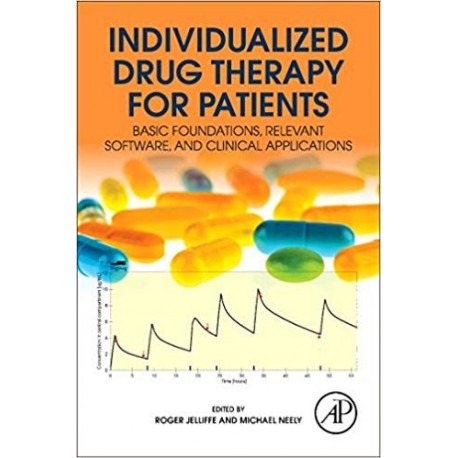

INDIVIDUALIZED DRUG THERAPY FOR PATIENTS
9780128033487
Más información
DESCRIPTION
- Uses pharmacokinetic approaches as the tools with which therapy is individualized
- Provides examples using specific software that illustrate how best to apply these approaches and to make sense of the more sophisticated mathematical foundations upon which this book is based
- Incorporates clinical cases throughout to illustrate the real-world benefits of using these approaches
- Focuses on quantitative approaches that maximize the precision with which dosage regimens of potentially toxic drugs can hit a desired therapeutic goal
TABLE OF CONTENTS
- Dedication
- List of Contributors
- Preface
- Reference
- Acknowledgments
- Introduction: Dont Just DoseChoose a Specific Target Goal, Suited to the Patients Need, and Dose to Hit it Most Precisely
- 1 Ways of ThinkingQualitative and Quantitative
- 2 Graphical Plots and Optical Illusions
- 3 Other Illusions Sharing This Feature of Perception
- 4 General Remarks About Dosing
- References
- Section I: Basic Techniques for Individualized Therapy
- Chapter 1. Basic Pharmacokinetics and Dynamics for Clinicians
- Abstract
- 1.1 Excretion is Usually Proportional to Amount or Concentration
- 1.2 Accumulation Takes Place by the Mirror Image of Elimination
- 1.3 Suiting Loading and Maintenance Doses to Each Other
- 1.4 The Basic IdeaDose and Half-TimeThey Let You Control the Total Amount of Drug You Permit the Patient to Have in the Body at Any Time
- 1.5 Events Following a Change in Daily Maintenance Dose
- 1.6 Events Following a Change in Excretion Rate
- 1.7 Separating Elimination Into Renal and Nonrenal Components
- 1.8 Adding More Compartments for a More Realistic Pharmacokinetic Model
- 1.9 Output Equations: Describing the Observations
- 1.10 Parameterizing the Model: Volume and Clearance or Volume and Rate Constant?
- 1.11 The Clearance Community in PK
- 1.12 A Current Clinical Issue: Augmented Renal Clearance in the ICU
- 1.13 Properties of Systems: Observability, Identifiability, and Controllability
- 1.14 Nonlinear Drug Systems
- 1.15 Conclusions
- References
- Chapter 2. Describing Drug Behavior in Groups of Patients
- Abstract
- 2.1 Early Approaches to Modeling
- 2.2 True Population Modeling Approaches
- References
- Chapter 3. Developing Maximally Precise Dosage Regimens for PatientsMultiple Model (MM) Dosage Design
- Abstract
- 3.1 Again, Select a Specific Target, Not a Range
- 3.2 The Separation Principle
- 3.3 The Way Around the Separation Principle: Multiple Model Dosage Design
- References
- Chapter 4. Optimizing Laboratory Assay Methods for Individualized Therapy
- Abstract
- 4.1 Introduction: Wrong Weighting of Data, Wrong PK Models, Wrong Doses
- 4.2 Percent Coefficient of Variation is Not the Correct Measure
- 4.3 Methods
- 4.4 Results: Application to Real Assay Data
- 4.5 Discussion: LLOQ is an Illusion
- 4.6 Conclusion
- Acknowledgments
- References
- Chapter 5. Evaluation of Renal Function
- Abstract
- 5.1 Classical Estimation of Creatinine Clearance (CCr), Based on Urinary Excretion
- 5.2 Problems With Estimates of CCr Using Only a Single Serum Creatinine (SCr) Sample
- 5.3 Estimating CCr from a Pair of SCr Samples at Known Times
- 5.4 The Final Overall Formula
- 5.5 When Did the Patients Renal Function Change?
- 5.6 Uncertainties in the Gold Standard Measurement of Creatinine Clearance
- 5.7 Comparison of Estimated Versus Measured Creatinine Clearance
- 5.8 Comparison With CockcroftGault Estimation When SCr is Stable
- 5.9 Should Ideal Body Weight Be Used Instead of Total Body Weight?
- 5.10 Changing SCrThe Direct Clinical Link Between the Patients Changing Renal Function and Drug Behavior
- 5.11 Summary
- References
- Chapter 1. Basic Pharmacokinetics and Dynamics for Clinicians
- Section II: The Clinical Software
- Chapter 6. Using the BestDose Clinical SoftwareExamples With Aminoglycosides
- Abstract
- 6.1 IntroductionThe BestDose Clinical Software
- 6.2 Two Representative DrugsAmikacin and Gentamicin
- 6.3 Planning the Initial Regimen
- 6.4 Analyzing a Gentamicin Patients Existing Data, and Developing the Adjusted Regimen
- 6.5 The Effect Model
- 6.6 Planning the New Adjusted Dosage Regimen
- 6.7 Summary
- References
- Chapter 7. Monitoring the Patient: Four Different Bayesian Methods to Make Individual Patient Drug Models
- Abstract
- 7.1 Introduction
- 7.2 But First, Weighted Nonlinear Least Squares Regression
- 7.3 Using Bayes Theorem in Analyzing Data, Using Parametric PK Models
- 7.4 Bayesian Analysis for Nonparametric (NP) Models
- 7.5 Hybrid Bayesian Analysis
- 7.6 The Interacting Multiple Model (IMM) Bayesian Approach to Unstable ICU Patients
- 7.7 Using the Augmented Population Model from the Hybrid as the Bayesian Prior for Subsequent IMM Analysis
- 7.8 Conclusion
- References
- Appendix: More Detail on Nonparametric Bayesian Analysis
- Chapter 8. Monitoring Each Patient Optimally: When to Obtain the Best Samples for Therapeutic Drug Monitoring
- Abstract
- 8.1 Introduction
- 8.2 Optimizing Therapeutic Drug Monitoring (TDM) Protocols and Policies
- 8.3 D-Optimal Design and Its Variants
- 8.4 D-Optimal Times Also Depend Upon the Dosage Format
- 8.5 Multiple Model Optimal (MMopt) design
- 8.6 New Specific Clinical Tasks that Can Also Be Optimized with WEIGHTED MMopt (wMMopt)
- 8.7 Conclusion
- References
- Chapter 9. Optimizing Individualized Drug Therapy in the ICU
- Abstract
- 9.1 Introduction
- 9.2 Renal Function
- 9.3 Apparent Volume of Distribution, Drug Elimination, and Clearance
- 9.4 Increased and Changing V and Augmented Renal Clearance in ICU Patients
- 9.5 Tracking Drug Behavior Optimally in Unstable Patients
- 9.6 An Illustrative Chronic Dialysis Patient With Sepsis
- 9.7 IMM Analysis of the Patients Data
- 9.8 Another Patient, Highly Unstable, With High Intraindividual Variability
- 9.9 Two New Moves to Further Improve the IMM Approach
- 9.10 Summary
- References
- Chapter 10. Quantitative Modeling of Diffusion Into Endocardial Vegetations, the Postantibiotic Effect, and Bacterial Growth and Kill
- Abstract
- 10.1 Introduction
- 10.2 Diffusion Into Endocardial Vegetations
- 10.3 Simulating a Small Microorganism
- 10.4 Modeling Bacterial Growth and Kill
- 10.5 An Illustrative Case
- Acknowledgements
- References
- Chapter 11. Individualizing Digoxin Therapy
- Abstract
- 11.1 Introduction
- 11.2 The Population Model of Digoxin
- 11.3 Implications for Dosage
- 11.4 Adjusting Initial Dosage to Body Weight and Renal Function
- 11.5 Variability in Response: The Need for Monitoring Serum Concentrations and Dosage Adjustment
- 11.6 The Very Wide Spectrum of Serum Digoxin Concentrations and Patient Responses
- 11.7 Management of Patients with Atrial Fibrillation and Flutter
- 11.8 An Illustrative Patient
- 11.9 Another Patient Who Converted Three Times but Relapsed
- 11.10 Another CaseA Very Large, Heavy Patient Who Did Not Convert
- 11.11 Ratios Between Central and Peripheral Compartments
- 11.12 The Effect of Serum Potassium
- 11.13 A Very Relevant Patient
- References
- Chapter 6. Using the BestDose Clinical SoftwareExamples With Aminoglycosides
- Section III: Clinical Applications of Individualized Therapy
- Chapter 12. Optimizing Single-Drug Antibacterial and Antifungal Therapy
- Abstract
- 12.1 Introduction
- 12.2 Minimum Inhibitory Concentration
- 12.3 Breakpoints
- 12.4 The Approach
- 12.5 Antifungal Agents
- 12.6 Use of Therapeutic Drug Management and Multiple Model Bayesian Adaptive Control of Dosage Regimens
- 12.7 Problems with Trough-Only Sampling
- 12.8 An Illustrative Patient
- 12.9 Issues in Fitting Data
- 12.10 The Approach to the Patient
- 12.11 Voriconazole
- 12.12 An Illustrative Patient
- 12.13 Evaluation of Dosage Guidelines
- 12.14 Another Illustrative Patient
- 12.15 Conclusion
- References
- Chapter 13. Combination Chemotherapy With Anti-Infective Agents
- Abstract
- 13.1 Why Employ Combination Therapy?
- 13.2 Increased Spectrum of Empirical Coverage
- 13.3 Increased Bacterial Kill with Additive or Synergistic Interaction
- 13.4 What are Synergy, Additivity, and Antagonism?
- 13.5 Suppression of Amplification of Less-Susceptible Subpopulations
- 13.6 Suppression of Protein Expression (If One Agent is a Protein Synthesis Inhibitor)
- 13.7 Summary
- References
- Chapter 14. Controlling Antiretroviral Therapy in Children and Adolescents with HIV Infection
- Abstract
- 14.1 Introduction
- 14.2 Pharmacokinetics (PK)
- 14.3 Pharmacodynamics (PD)
- 14.4 Pharmacogenomics (PG)
- 14.5 ARV Therapeutic Drug Monitoring/Management (TDM)
- 14.6 Multiple-Model Bayesian Adaptive Control: Case Examples
- 14.7 Patients
- 14.8 Patient 1. General Techniques and the Need for Nonstandard Dosage Schedules
- 14.9 Patient 2. Unsuspected Impaired Clearance: Patients Needing Smaller Doses Than Usual
- 14.10 Patient 3. Low Concentrations: Underdosing or Poor Adherence?
- 14.11 Patient 4. Adolescents: Should They Get Adult Doses?
- 14.12 Patient 5. Extrapolating from Adults to Children
- 14.13 Moving Forward
- Acknowledgments
- References
- Chapter 15. Individualizing Tuberculosis Therapy
- Abstract
- 15.1 Introduction: The WHO and Public Health Approach to Anti-TB Drug Dosing: One-Size-Fits-All
- 15.2 The Rationale for Dose Individualization of Anti-TB Drugs
- 15.3 How to Individualize Anti-TB Drug Regimens
- 15.4 Conclusions
- References
- Chapter 16. Individualizing Transplant Therapy
- Abstract
- 16.1 Introduction
- 16.2 Calcineurin Inhibitors (CNI)
- 16.3 Overall Summary
- References
- Chapter 17. Individualizing Dosage Regimens of Antineoplastic Agents
- Abstract
- 17.1 History and Current Status
- 17.2 Conclusions
- References
- Chapter 18. Controlling Busulfan Therapy in Children
- Abstract
- 18.1 Introduction
- 18.2 Discussion
- 18.3 Conclusion
- References
- Chapter 19. Individualizing Antiepileptic Therapy for Patients
- Abstract
- 19.1 Introduction
- 19.2 Population Modeling: Results
- 19.3 External Validation
- 19.4 More Complex Nonlinear PK Models
- 19.5 Indications for TDM and Individualizing AED Dosage
- 19.6 Conclusion
- Acknowledgments
- References
- Chapter 20. Individualizing Drug Therapy in the Elderly
- Abstract
- 20.1 Introduction
- 20.2 Highlights of Some Biological Aspects of Aging
- 20.3 Pharmacodynamic Changes in the Elderly and Their Therapeutic Implications
- 20.4 The Renal Aging Process and its Pharmacokinetic Consequences
- 20.5 A Special Case: Intraindividual Variability in the Elderly
- 20.6 Conclusions and Perspectives
- Acknowledgments
- References
- Chapter 21. The Present and Future State of Individualized Therapy
- Abstract
- 21.1 Models of Large, Nonlinear Systems of Multiple Interacting Drugs
- 21.2 Equations Without Constant Coefficients
- 21.3 The Pharmaceutical Industry, Doses, Patients, and Missed Opportunities
- 21.4 The Pharmaceutical Industry and Clinical Trials
- 21.5 Bayes Theorem and Medical Decisions
- 21.6 The Two-Armed Bandit
- 21.7 ConclusionMonitor Each Patient Optimally and Control the System Optimally
- References
- Chapter 12. Optimizing Single-Drug Antibacterial and Antifungal Therapy
- Index
Reseñas
No hay reseñas de clientes en este momento.
10 otros productos de la misma categoría:
-

KIT DE CRIOTERAPIA CRY-AC 0.3 L
1 025,00 €
-

LAPARO ASPIRE VER. MEDIUM. LAPAROSCOPIC TRAINER
680,50 €
-

ADAPTADOR DE CORRIENTE ELECTRICA OMRON M2, M3, M6 IT, M7, M10 IT
19,80 €
-

FUNDA FONENDOSCOPIO CARE COLLECTION
9,95 €
-

FUNDA FONENDOSCOPIO VIRUS COLLECTION
9,95 €
-

FUNDA FONENDOSCOPIO EIGHTIES COLLECTION
9,95 €
-

GUIA PRACTICA PARA PROFESORES DE MEDICINA
72,20 € -5% 76,00 €
-

LAPARO ASPIRE VER. ESSENTIAL LAPAROSCOPIC TRAINER
638,28 €
-

FUNDA FONENDOSCOPIO ORGANOS
9,95 €
-
ESTUCHE FONENDOSCOPIO CON SOLAPA INTERIOR
19,95 €


LibreriaMedica.es
 Conócenos
 Somos una librería especializada en Ciencias de la Salud fundada en 1980. La librería nació con el objetivo de atender la demanda de libros especializados en ciencias de la salud. Con el paso de los años hemos ampliado nuestra oferta comercial incorporando la venta material médico-sanitario.
¡Lee aquí el resto!

Estudiantes
 Estudiantes
Estudiante de Ciencias de la Salud, para tí disponemos de toda la bibliografía recomendada y complementaria que necesitarás durante tus estudios de Medicina, Enfermería, Fisioterapia, Farmacia, Podología, Terapia Ocupacional, Ciencias de la nutrición, Veterinaria, etc.
También te ofrecemos todo el material sanitario que puedas necesitar para el desarrollo de tus prácticas.
Los puedes ver aquí